1. A brand new 3M N-95 mask smells a little like vanilla ice cream.
2. All nurses are amazing.
3. You can’t shock an ER nurse.
4. ICU nurses will save your life.
5. Nurses who have ever cared for COVID patients are certified Badass, will chew steel for lunch and spit out nails.
6. I would go into battle with any nurse at my side.
6a. Nurses Aides are the infantry in healthcare, they do the grunt work and come up with most brilliant observations in the fight. The view that is often overlooked by the higher ups.
7. There is a whole population of younger people (35-60 yo) who’ve contracted COVID who are alive, on high flow and high percentage oxygen, can’t move more than side to side, and are trapped as chronic pulmonary disease patients likely forever.
8. There is a whole new population of younger people (35-60 yo) who’ve contracted COVID who are now on hemodialysis as well as chronic pulmonary disease patients.
9. The medical system will have to re-create the “sanatorium” system for these patients for many years to come to aggregate these patients under the care of expert Doctors and Nurses if they are to have any hope of return to society.
10. Most of what we give now (in terms of medications) and the way we give it now is minimally effective.
11. The best treatments are oxygen, prone positioning, nutrition, great nursing care, and love.
12. It is genuinely frightening to walk into a building every day knowing that you could get a deadly disease, pass it to everyone you know, and become just another statistic, a mere number in a ledger.
13. It is frightening to realize that this is going to be the way it is for a VERY long time (even when there is a vaccine).
14. Much the same way that “every Marine is a rifleman first”. Every physician should be capable of intelligently and effectively managing a patient from top to bottom, specialty comes later. This should be reviewed on a certain timetable, not by testing, but by doing.
As always, wash your hands, don’t touch your face, wear masks in public, do the social distance thing, and practice love and kindness. There is too much hatred in the world.
The subject of health
insurance for all is not a new concept, in fact it goes back to the time
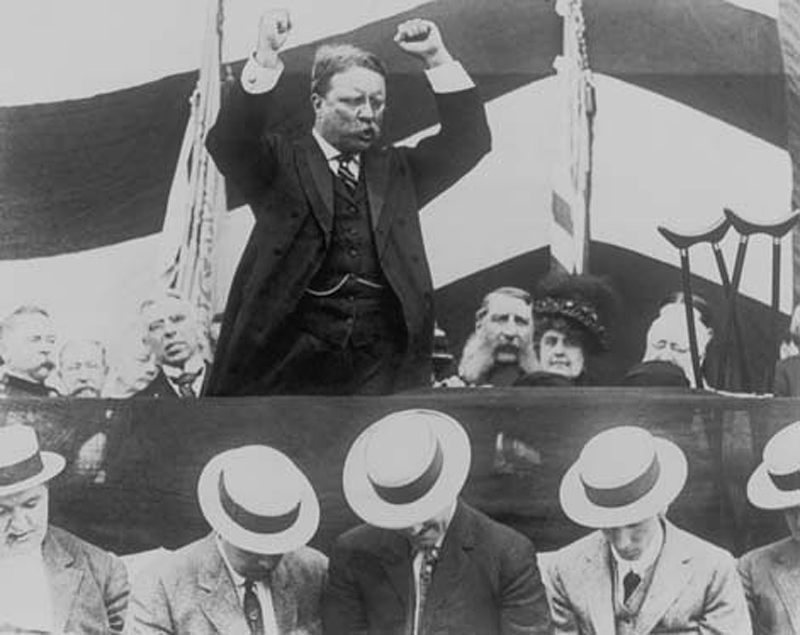
of Theodore Roosevelt whose election platform in 1912 prominently featured
(among other progressive planks) a plan for a National Health Insurance (“Progressive Party Platform of
1912,” 2019). Unfortunately for Roosevelt (and for the country-in my
humble opinion) he was not elected, and the idea of a comprehensive National
Health Plan had to wait until after World War II and into the presidency of
Harry S. Truman.
On November 19, 1945, Truman sent a letter to Congress outlining
the plan for the creation of a National Health Insurance Fund which was to be
open to all Americans. It would have provided for total health care coverage
for individuals, paying for doctor’s visits, hospital stays, laboratory
services, dental care, and nursing services. Suffice it say that this
measure was successfully blocked in congress by the strong lobbying efforts of
multiple Medical Industry special interest groups, primarily among them the
American Medical Association (ironically enough as that group now champions a
single payer system). Taken in context however, this was the period of the
“Red Scare” when anything that even remotely smacked of Communism or its cousin
Socialism (gasp, that word!) was shied away from due to the relentless
hounding and unfounded charges of anti-Americanism brought by Senator Joseph
McCarthy (“Joseph McCarthy
United States Senator,” 2019) and his ilk. These charges could
(and did) ruin careers and destroyed people’s lives. So… the deadly
combination of high-priced lobbyists and McCarthyism quashed the idea of “Nationalized
Medicine” for many years (although Great Britain and Canada started it and
maintain excellent National Health Services to this day).
John F. Kennedy made his own push for a
more limited National Health Plan that would cover seniors after a national
survey showed that 56% of Americans over 65 had no health coverage. But the
events of the early 1960’s conspired to hold that off until president Lyndon
B. Johnson (the master congressional deal maker) was able to get Medicare over
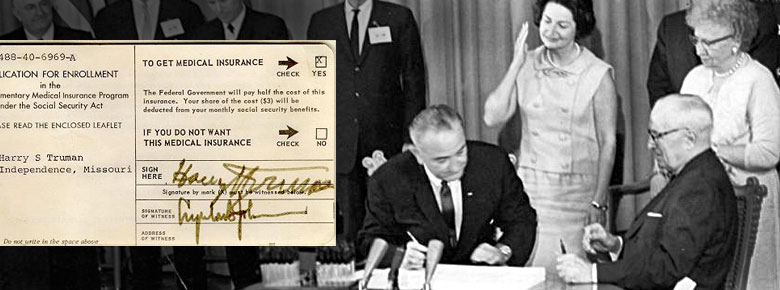
the line and signed in 1965 with coverage for those over 65 beginning in 1966. Harry
Truman and his wife Bess were Medicare recipients numbers 1 and 2.
Timeline
1966 – Medicare Part A (Hospitalization Coverage) and Part B
(Coverage for Doctor’s Visits) begins.
1972 – President Richard Nixon signed into law expanded coverage
to those under 65 with a chronic long-term disability or end stage renal
failure on dialysis (hemodialysis or peritoneal dialysis).
1980 – Home Care Services were added. “Medigap” insurance plans
came under Federal Regulation.
1982 – Hospice Services were added
1988 – Caps placed on Medicare A and B outlay in case of catastrophic
illness. States required to provide funding for Part B premiums for Qualified
Medicare Beneficiaries who are at the poverty line.
1990’s – Medicare Part C enacted. This led to the creation of
Medicare Advantage Plans otherwise known as Managed Medicare.
2000 – People under the age of 65 with ALS can get benefits
without a waiting period if approved for Social Security Disability (SSDI),
normally there is a 24 month wait.
2003 – President George W. Bush enacted Medicare Part D which is
an optional prescription benefit which can be purchased alone, combined with
Medicare part A and B or combined with a Medicare Part C plan (confused yet?).
2010 – Patient Protection and Affordable Care Act (ACA) was
enacted which seeks to decrease costs to Medicare while improving quality of
care.
2015 – Medicare and CHIP Reauthorization Act (MACRA) passed.
Changes the way Medicare pays physicians to try and improve quality of care at
a lower cost to Medicare. Essentially, Doctors must provide better quality of
care or else they get paid less.
Closing thoughts
As of this writing, there were approximately 60.6 million people
on Medicare costing 705.9 billion dollars in 2017 (Anderson, 2019). This is about 20% of
total health spending in the US.
Medicare now stands to account for 18% of the total federal
spending by 2028 with the result that the Part A trust fund will be
depleted and the difference needs to be made up by payroll taxes (not likely to
cover the total Part A spending). As ACA has helped slow the growth in Medicare
spending while improving quality, it is unlikely to “bankrupt Medicare”, but
there must be something done that will provide better quality care, at less
cost, with better coverage for all Americans, returning to the original vision
of Teddy Roosevelt and Harry Truman.


 Life, Health, and Policy.