Images, Memories, and Hopes

In the spaces between seeing patients, calling families, and writing notes come thoughts. Psychologists would call them “invasive”, and yes I know that left unexamined, these things can be dangerous. Luckily, we have our social worker who regularly (and insightfully) does an informal debrief on us.

She probably thinks we don’t notice but we do and we’re thankful.

When did it really start?

The gift shop has St. Patrick’s Day stuff.

When we come into work in the mornings, we are temperature checked and then need to swipe our ID cards into a card reader. What this does, is to document that we’ve been checked and presumably that we are aware of the danger of going to work.

When we were talking about when it really started, an image from this morning came to mind. The card reader is right outside of the Gift Shop. When you look into the gift shop , it’s still full of St. Patrick’s Day cards, green hats, St. Patty Cards, and the very beginning of Easter Chocolate Bunnies.

The gift shop was closed in early March, when all the volunteers were sent home and now sits like a clock frozen at the time of a disaster, it’s cheerful Trinkets heralding holidays that were just days of anxiety and fear in the hospital in which it lives.

The days after that came almost unnoticed, the hours of terror turning us all into zombies, lumbering on under increasingly heavy loads until after two weeks it became normal.

Like Monuments To The Lost

This morning on rounds my team and I had to walk by the security holding closet. This is the closet that hospital security uses to keep an admitted patient’s belongings until they are being discharged or until family comes to retrieve them.

Now normally this isn’t even an after-thought and I’d be hard pressed to even tell you were it is.

I know where it is now.
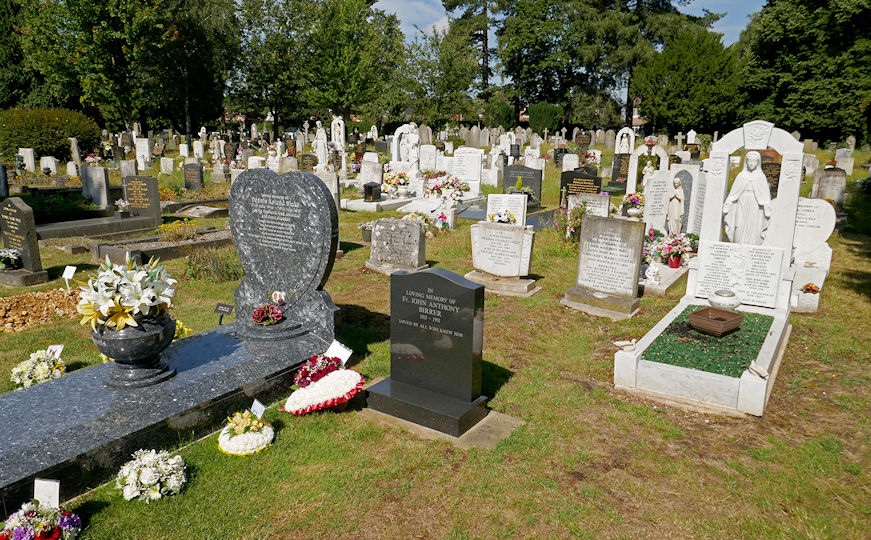
Like monuments to those lost

Security was emptying the closet of unclaimed bags of personal effects and getting them ready for long-term storage. Hundreds of bags all stacked neatly along the hallway; generic hospital issue clear bags, shopping bags, backpacks with decorative patches, and large inter office envelopes all being labeled with the names of those lost to Covid, awaiting some future relative who would claim them.

As we walked away from that sight, it reminded me of headstones, marking the life of someone who came to us and never left, their lives remembered in a small pile of clothing and shoes.

Images that stoke a memory.

Hope?

Recently, there have been reports of the possible effectiveness of a drug by the name of dexamethasone in treating Covid-19.
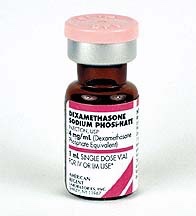
Dexamethasone

Dexamethasone is a steroid and what steroids do is suppress the immune response. If you recall, the danger of Covid is the way it stimulates the immune response into destroying the body’s lungs and kidneys. A drug (like Remdisivir and dexamethasone ) that decreases the immune response should help this phase of the disease.

The preliminary reports show that when given at the right time, it improves short term survival by five percent. There is no data about quality of life or long term survival.

So it’s a good thing. Better would be that you wear a mask and don’t get sick in the first place.

Wash your hands

Don’t touch your face

Social distance

Wear a mask

Eat right

Sleep

Exercise

… and love one another.
“But How Did It Feel?”

I live and work in New York (Long Island specifically) and things have pretty much settled down at our hospitals.

The make-shift ICUs have been dismantled, COVID patients on vents relegated to a small area in the back of the MICU (Medical ICU). The non-intubated people housed in three hallways of the unit that had always been designated for infectious diseases. Those areas still have the COVID look to them, bags taped to walls and blue plastic gowns hung from hooks, but there is less desperation than there was.

The patients that were going to die in the ICUs are slowly dying, regardless of what the families want and what any doctor could ever do. Those not on vents are going home (with oxygen and forever damaged lungs -pulmonary cripples) or still short of breath on high concentration of oxygen and clearly going nowhere.

At least the families can come to the windows and see their relatives from outside the buildings. And we’re beginning to let some families come visit those near death.

Everywhere else in the hospital it’s different. We still all wear masks (a habit that will probably live on for a good long time) but the rooms are now immaculate, the floors shiny and the walls all freshly painted. All hint of the horror covered in bright white with earth-tone trim.

I was rounding with my team this week when our social worker (a brilliant woman who was “parachuted” into the hospital from our hospice affiliate on a grant to help us – she arrived as the “tide” was washing out) noted the look in our eyes and the blank eyes of the nurses on the floors and asked us, “but how did it feel?”

It Was Dark

The lights weren’t bright enough

As a group, including some floor and ICU staff, we all had similar recollections.

It was dark. Not literally, but no matter how many lights were on – the hallways, rooms, and offices felt darker than they should have been. The atmosphere inside was “heavy”, hard to breath.

We all agreed that we actually couldn’t remember what it was like… more like we didn’t want to remember it, but we all had individual “moments” we remembered. One nurse said that she couldn’t remember anything about those weeks, but vividly described an incident in which two young patients coded in the same room and they had to choose which one to intubate first and which one to let die.

A social worker recalls helping a group of nurses communicate with a patient who spoke Greek and was isolated and scared, they didn’t have to care so much, she said, but it was the act of caring so hard that maintained their sanity.

I recall the surreal nature of one of our make-shift ICUs towards the end of the first wave, messy, music from phones in the background, “bunny suits” tied around everyone’s waist (they are hot to wear all day).

When these snippets of shared memories are recalled, everyone looks the same, they get glassy eyed, as if peering into a dark distant place, then everyone says the same things.

“I can’t remember much about it.”

“It’s too soon-I don’t want to think about it.”

“I had no one to talk about this with anyway. “

“It pisses me off that everyone outside is bitching and moaning about being BORED!”

“I’m scared, I don’t think I could do it again. But I’m scared that we’re gonna have to, no one is paying attention!”

I don’t know how I’ll be able to do it again, but I will… as will everyone else, no matter how scared they are. It’s what we do.

Covid Update

So, I don’t care what you think of New York or it’s governor, New York and the Northeast (except Vermont) has done an amazing job in decreasing cases of Covid.

I fear for all those states that thought we were joking or that we were over dramatic “snowflakes” ( I invite you to see the refrigerated trucks behind the hospital). You are now being hit with it worse than we were.

Wear all the PPE.

I address the new Covid Warriors (healthcare workers) :

Patients should get high flow O2 and lay them prone. All of the meds we have now DON’T WORK!

Isolation is important as is hand hygiene.

Eat well, sleep, wear your mask it’s not political, it’s reality, exercise. Keep relative isolation from vulnerable family members.

Scrubs, head covers with buttons on the sides for the mask straps (look on Etsy) and “Covid sneakers” that you change out of outside your house and throw in the wash before walking in.

Be good to yourself, it’s gonna suck and you’ll likely end up as damaged as we are in the NE. We’ll be here when you need help like you helped us.

New Mask

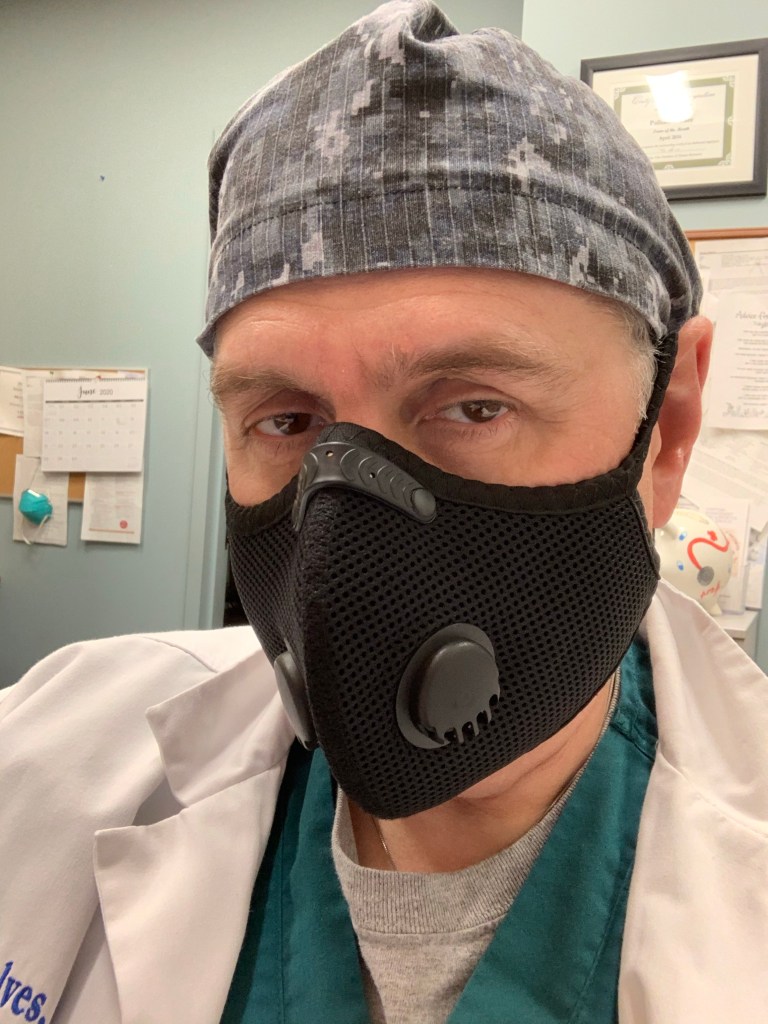
On a not serious note, I got a new mask.

Base Camp Mask

Since we’re all going to need masks for the foreseeable future, I ordered a very cool looking and comfortable mask. It is super comfortable with a Velcro strap around the back of the neck (takes the strain off the ears) very breathable with replaceable filters inside.

Called Base Camp masks, it’s good quality, solid shipping and less than 40 dollars.

You’ll spend more on boxes of cheap masks of poor quality that don’t look near as cool. Btw, I’m not getting paid to show you the mask, I just think it’s cool.

As always, wash ya hands, wear a mask, social distance, and love each other… we are all we have.

Rushing Towards the “New Normal”

So the “inside” is looking a lot less like the “inside” every day.

When I resumed these posts, It was at the run-up to the surge in New York (Long Island more specifically) and I watched an orthopedic floor turned into an ICU, I saw nice clean step-down beds (were people go to have some cardiac monitoring – but nothing too “serious”) turned into ICU beds, a holding room for elective surgeries turned into “the fishbowl” of Covid patients were patients watched each other suffocate, and even ambulatory surgery units turned into Covid – care floors.

Like the receeding tide, I am seeing units being returned to their former functions, being made “clean” again. More and more, we are allowing families to at least come and see their sickest relatives before they are necessarily near death. We are even going to open a new cafeteria expansion next week (3 months late because of Covid).

There is a sort of strange melancholy to this process, as the huge bags of “dirty” supplies get thrown out and the rooms are “terminally cleaned” it feels like the day after christmas, after the superbowl, after the world series… the world returning to whatever passed for normal, the exploits and adventures spoken only in “remember whens”.

I look at the sparkling clean rooms and still see the hundreds of patients who suffered and died in them and I don’t want them to be forgotten, their suffering should not have been in vain.

And then I see the crowds rushing to bars and swimming pools and such flouting common-sense self protections and think, “yeah they did die in vain, and it is going to happen again, somewhere else if not here”.

I want it to be over.

I am afraid it is not.

As Always

Wash your hands

Don’t touch your face

Wear a mask… you aren’t freaking superman / captain marvel.

Exercise, eat right.

Love one another, hate doesn’t make anyone better.

Observations On A Friday Evening.

1. A brand new 3M N-95 mask smells a little like vanilla ice cream.

2. All nurses are amazing.

3. You can’t shock an ER nurse.

4. ICU nurses will save your life.

5. Nurses who have ever cared for COVID patients are certified Badass, will chew steel for lunch and spit out nails.

6. I would go into battle with any nurse at my side.

6a. Nurses Aides are the infantry in healthcare, they do the grunt work and come up with most brilliant observations in the fight. The view that is often overlooked by the higher ups.

7. There is a whole population of younger people (35-60 yo) who’ve contracted COVID who are alive, on high flow and high percentage oxygen, can’t move more than side to side, and are trapped as chronic pulmonary disease patients likely forever.

8. There is a whole new population of younger people (35-60 yo) who’ve contracted COVID who are now on hemodialysis as well as chronic pulmonary disease patients.

9. The medical system will have to re-create the “sanatorium” system for these patients for many years to come to aggregate these patients under the care of expert Doctors and Nurses if they are to have any hope of return to society.

10. Most of what we give now (in terms of medications) and the way we give it now is minimally effective.

11. The best treatments are oxygen, prone positioning, nutrition, great nursing care, and love.

12. It is genuinely frightening to walk into a building every day knowing that you could get a deadly disease, pass it to everyone you know, and become just another statistic, a mere number in a ledger.

13. It is frightening to realize that this is going to be the way it is for a VERY long time (even when there is a vaccine).

14. Much the same way that “every Marine is a rifleman first”. Every physician should be capable of intelligently and effectively managing a patient from top to bottom, specialty comes later. This should be reviewed on a certain timetable, not by testing, but by doing.

As always, wash your hands, don’t touch your face, wear masks in public, do the social distance thing, and practice love and kindness. There is too much hatred in the world.

Why Ventilators in Covid – 19?

How Do We Breathe?

Ok so we know how Covid -19 works and that it attacks the lungs (and kidneys). Why do some people end up on Ventilators and why do some end up not needing them?

Short answer: We don’t know.

That is what makes this thing so difficult to predict and scary. It isn’t “I’m young and healthy, I’ll be ok!” it seems to be either some kind of genetic thing or viral load or something that causes some people – regardless of age or health to have respiratory failure and some people to be OK. I’ve seen personally 96 year olds with all kinds of co-Morbidities (other things going on other than Covid), get better and go home and a 37-year-old otherwise healthy man die of respiratory failure. So yeah, we don’t know.

But before we talk about what ventilators are and why we use them, we need to get on the same page.

Definitions

Respirator: A form of PPE (personal protective equipment) that has filters and generally (but not always) a motor and a source of additional air – like a scuba tank . Think of the air tanks and masks worn by firefighters, those are respirators. There are smaller versions that are worn by surgeons in hospitals when in a toxic situation – usually in the movies.

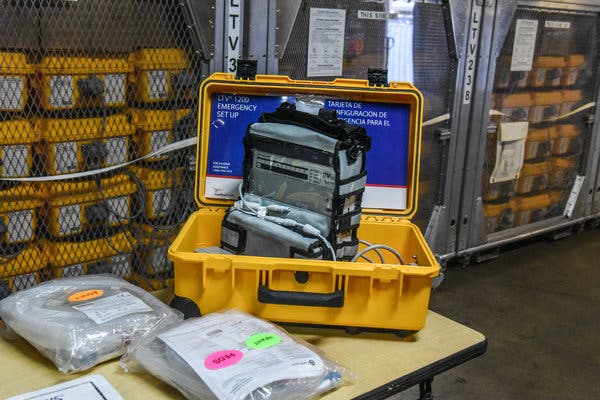
Ventilator: A machine that blows air (of differing oxygen percentages and pressures) into the lungs and takes the air out. We call these things ventilators because what they do is push air in and take air out (Ventilate the lungs) – they DON’T inject air or oxygen into the lungs.

How we breathe naturally

Natural Breathing

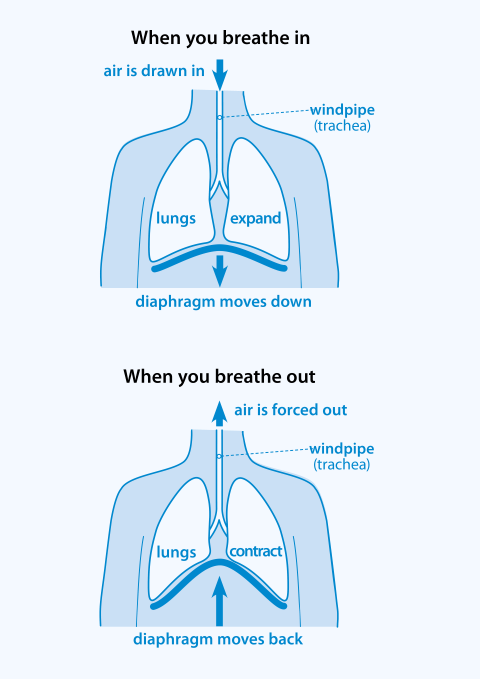
When we breathe naturally our diaphragms (the wide muscle between your chest and your abdomen) contract (move down) and since the only way into your lungs is through your throat (trachea), the air whooshes in. When we breathe out, the diaphragms relax and the air comes out.

That’s the natural way.

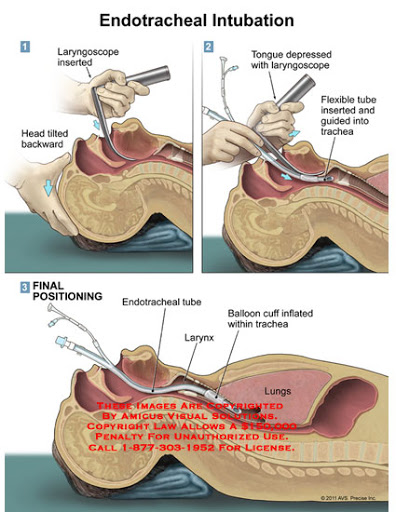
When we use ventilators, we DON’T do it the natural way. Instead of letting the diaphragms and the body take in air like the tides (in and out), we stick a long plastic tube into the throat, between the vocal cords, inflate a little balloon at the end of the tube to seal it up and blow a certain amount of air with a certain amount of oxygen in to it and then take it out.

Intubation

When someone is intubated (like during surgery or for a serious illness like Covid), it happens like in the diagram below.

A doctor puts a thing called a laryngoscope which is basically a large long spoon, that is used to move the tongue out of the way and while staring intently (and getting all kinds of droplets all over their face) slides the tube into the trachea.

The balloon is inflated to prevent movement and to seal it off from outside stuff and then it is taped in place on the face. You cannot talk or eat when you are intubated.

In the OR ( Operating Room) this is done in very controlled circumstances, quiet with music in the background – everyone smiling.

In Covid, there is usually anxiety, fear, and a good bit of yelling. These Docs and Respiratory Therapists are pro’s though and they get it done successfully. Once you are intubated, you are put on a mechanical ventilator.

Ventilators

Basics of a Ventilator

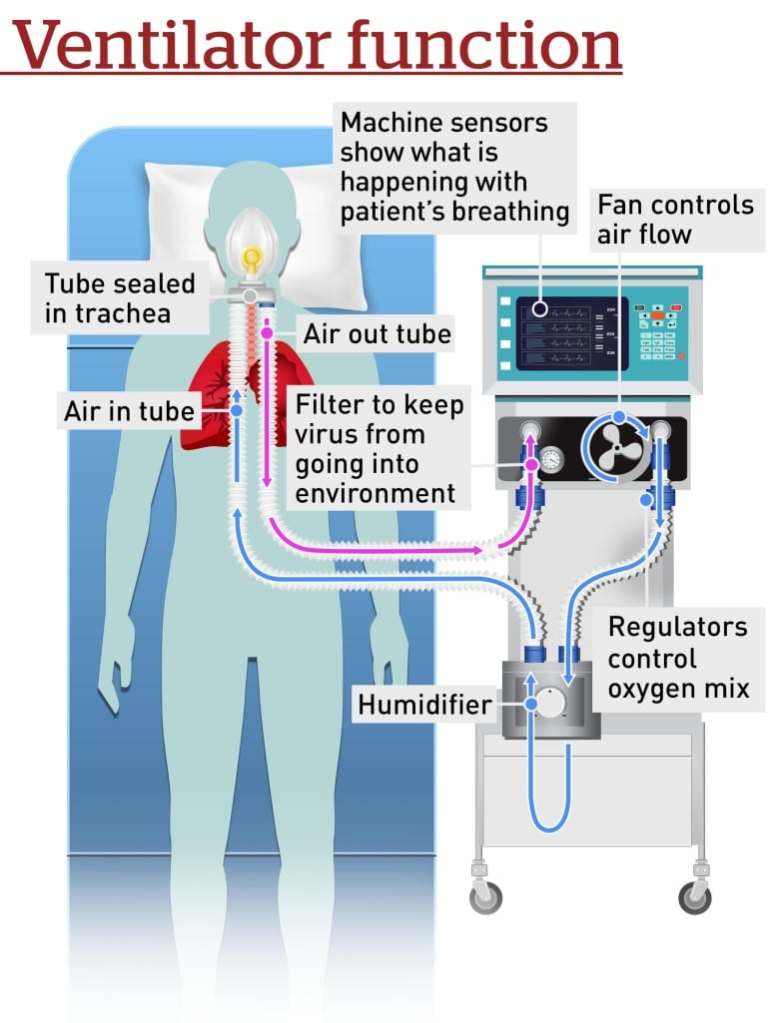
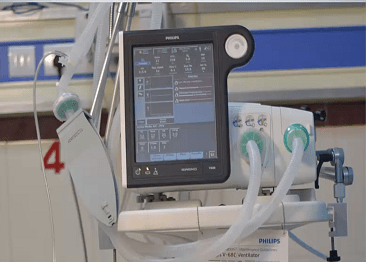
Ventilators consist of several parts. There is the tube that comes out of the patient that is split (soon after it comes out of the person) into the tube that brings the air into the person and the tube that takes air away.

They have built in filters to keep bad stuff (including viruses) from spewing into the air.

There is a fan that is connected to a bunch of electronics that attaches to oxygen tanks. The electronics monitor how much is going in, the temperature of the air, and a whole bunch of other complicated stuff. The fan pushes air through a humidifier (dry air is bad) and then into the patient (like a pump pushes air into your tires at the gas station).

So air (mixed with oxygen and humidification) goes in, and then it lets the air out. Room air has 21% Oxygen (the rest is carbon dioxide, nitrogen, and other gasses). If the body doesn’t have enough oxygen in the blood (there are ways to measure that), then the Docs turn up the oxygen in the air that goes into the lungs, they can go all the way to 100%. When you get better, then the Docs take the tube out.

So Why?

In the last post we talked about how Covid attacks the lungs (and kidneys). When the air sacs get damaged, the body can’t take in enough oxygen from the 21% floating around in the air. It also can’t get rid of the Carbon Dioxide (CO2) that our bodies produce (we make a lot of that). So, in order to do both, the person starts to breath real hard. They also need to move the blood around faster so the heart begins to beat faster.

The problem is that in Covid, the person is coughing a lot.

If they can’t breath enough through the coughing to keep their oxygen in their blood at normal levels (between 88% and 100%), Docs will start them on Oxygen, usually through a face mask.

If the oxygen in their blood is still too low, the person begins to tire out and they will need help to breath. So before this happens they get intubated and put on ventilators.

This isn’t a great sign.

But, there is hope. As we learn more about this bastard, we figure out what works and what doesn’t. We are gentler and have learned that we can tolerate lower oxygen levels.

I’ve seen many people come off ventilators (we call them “vents” – so you’ll sound cool to your friends), and the more good real treatments we get, the more people will be coming off.

Bottom Line

Wash your hands like a maniac… please.

Wear a face mask when you go out anywhere that you might run into people where you have to get closer than six feet.

Don’t touch your face.

When the shortages go away, get hand sanitizer and use it all the time.

Do the Social Distancing thing.

Please Be Safe.

Next Time: Whats All The Talk About Testing?